


Published
9 November 2026There is an interesting shift taking place across Australia’s private capital markets. Capital remains available, but the conditions under which it is deployed are changing.
Higher borrowing costs, pressure on household and business cash flows, and a more cautious investment environment have altered the way investors assess opportunities. Where growth potential and ambitious forecasts once commanded significant attention, there is now a renewed emphasis on sustainable earnings, cash flow, management capability and the underlying quality of a business.
As Bob Neill, Partner at Madison Branson Capital, observes:
“A business can be profitable without necessarily being investment-ready. Investors want to understand not just the earnings being generated today, but how sustainable those earnings are, the risks underpinning them and the capacity of the business to deliver future growth.
This does not mean investors have lost their appetite for growth. Rather, the balance between risk and return is being recalibrated.
We are seeing this particularly among private investors and family offices, where established mid-market businesses with defensible market positions and predictable cash flows are attracting interest. For many investors, the opportunity to acquire or support a profitable operating business, with tangible earnings and a clear pathway to value creation, is becoming increasingly compelling.
At the same time, institutional and international capital continues to recognise the long-term opportunity within Australia’s fragmented financial services and private business sectors. Ironbark Financial Group’s recently announced $255.9 million investment from Merchant Wealth Partners is one example of the scale of capital prepared to support established platforms with opportunities for further consolidation and growth.
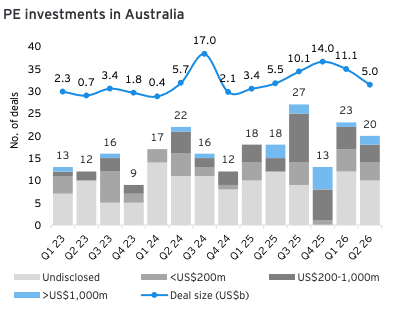
Source: EY Australia Private Equity Quarterly Update Q2 2026
For business owners, this has implications well beyond the immediate availability of funding. The assumptions underpinning a capital raise, the valuation of a business and the price ultimately achievable in a sale are becoming more closely connected.
A business seeking growth capital today must consider how that funding will translate into sustainable earnings tomorrow. Equally, an owner contemplating succession or an eventual exit needs to understand how an investor or acquirer will assess future performance, risks and capital requirements.
The conditions under which a business raises capital today can have a direct bearing on how it is valued tomorrow. Decisions around funding structures, shareholder arrangements, acquisitions and reinvestment all influence the quality of earnings, risk profile and ultimately the attractiveness of a business to future investors or acquirers.
Yet these decisions are often considered in isolation. Capital is raised to fund an immediate opportunity, valuations are sought when a transaction arises, and succession planning frequently begins only when an owner starts contemplating an exit.
In our experience, the strongest outcomes emerge when these decisions are considered earlier and as part of a broader commercial strategy.
It is a perspective we increasingly observe across Madison Branson Capital, particularly following our integration with Seaview Consulting in July. Working across capital markets, business valuations and M&A provides a valuable view of how decisions made at one stage of a business’s development influence outcomes at another.
As capital becomes more discerning, businesses demonstrating sustainable earnings, sound governance, appropriate capital structures and credible growth strategies will be better positioned to attract investment, pursue acquisitions or achieve an orderly succession.
Ultimately, the changing private capital market is not simply redefining what investors are prepared to pay. It is placing greater emphasis on how business owners build value in the first place. And that may prove to be the more significant shift.
